

MediMe

Insurance Intelligence Infrastructure

The operating system for autonomous insurance.

A system that understands insurance information, identifies what needs attention and moves the work forward — from first contact through sales, service, renewal and claims.

Every recommendation is shown with the source it rests on. Material actions require a professional's approval.

Built for
Carriers
Agencies
Brokers
MediMeWork queueDemo data
What needs attention

Health policy renewal

Needs approval

D. Levi · Renews in 21 days

Finding

One coverage condition in the renewing policy differs from the policy in force. It needs review before renewal.

Source
  • Renewing policy · p. 4 · clause 3.2
  • Policy in force · p. 4 · clause 3.2
  1. SystemDocument identified and filed to the client case
  2. SystemChanges checked against existing information
  3. ProfessionalReview the finding and approve the next step
  4. SystemCarry out permitted actions, update systems, follow up
Proposed action

Send the client a summary of changes and schedule a renewal call.

Demo data. The level of independence is set per process, within defined permissions, rules and approval points.
ISO/IEC 27001
Trust, built in
  • ISO/IEC 27001 certified
    Information security management, independently certified.
  • Source-linked output
    Each delivered field references its document, page and section.
  • Explicit field states
    Verified against a defined check, needs review, missing or blocked. Never a silent guess.
Visit the Trust Center

The challenge

The agent has become the link between every system.

The client writes on WhatsApp, their details sit in the CRM, the policy is in the carrier portal, the documents are in email and the follow-up lives in a task list. To handle one request, the professional moves between screens, copies data and tries to remember what has been done and what is still missing.

An insurance agent on the phone while typing on a laptop, facing two monitors and a desk covered in documents and sticky notes.

Today

The professional is the manual bridge

  • WhatsApp
  • CRM
  • Carrier portal
  • Email
  • Task list

Five places for one request

  • Moving between 5–8 systems and screensEvery request starts with a search: where the information is and what has been done.
  • Manual re-keying of fieldsThe same data is typed again, from one system to the next.
  • Responding after the factGaps and renewals surface when the client calls, not before.
  • Administrative fatigueTime goes to operations instead of professional judgment.

A professional at a tidy desk with a single monitor, reading a document with focus.

With MediMe

One workspace that moves the work forward

  • One client case

Connected systems are operated behind the scenes

  • One workspaceThe client, the information and the handling sit in a single case.
  • Synchronization behind the scenesThe system coordinates actions across connected tools and updates statuses.
  • Proactive detection of gaps and renewalsCases are reviewed ahead of renewal or when new information arrives.
  • Focus on decisionsEach recommendation comes with its explanation, supporting information and proposed action.

Enterprise systems and carrier portals keep doing their job. MediMe connects them through available interfaces and permissions.

The definition

What does “an autonomous insurance system” mean?

Autonomy is the ability to drive a business process and keep handling it over time — from receiving information to tracking the outcome.

  1. Receive information

    From documents, requests and authorized systems.

  2. Understand what it means

    Who the client is, what is already covered and which policy version applies.

  3. Identify the need

    What changed, what is missing and what needs attention.

  4. Prepare a decision

    The finding, the explanation and the source it rests on.

  5. Carry out permitted actions

    Within defined permissions, rules and approval points.

    After approval, where required

  6. Track the outcome

    Through to completion, flagging delays and exceptions.

In insurance, every action depends on context.

MediMe's system connects that understanding to the actual work, within defined permissions, rules and approval points.

What must be understood before any action

  • Who the client is
  • What is already covered
  • Which policy version applies
  • What the exclusions are
  • What has changed
  • What is permitted

Capabilities

What can a system like this do?

Six capabilities that cover the daily work, from knowing the portfolio to an operational view for management.

What the capabilities run on

A deterministic engine built for insurance.

The system turns insurance information from documents and authorized systems into one data structure. The processes run on that structure: by defined rules, with a source for every finding.

Deterministic
The same input yields the same result. When a finding has no basis in a source, the system says so and does not fill it in.
Source-linked
Each finding points to the document, page and clause it rests on.
Auditable
Sources, decisions and actions are recorded, so any process can be replayed.

Know the insurance portfolio

Collect information from documents and authorized systems, read policies, riders and exclusions into one structure, compare coverage and identify what is missing. That is the picture professional handling can rest on.

Initiate care for existing clients

Review cases ahead of renewal or when new information arrives, identify possible gaps and duplications, prioritize cases and prepare a reasoned action plan for review.

Support claims

Collect documents, check completeness, locate the relevant coverage clauses, prepare the file for handling and track requirements and status.

Professional rulings and decisions on eligibility and payment stay with authorized staff.

An insurance agent explaining to a client at a table, with a laptop and documents between them.

Advance sales processes

Accompany a lead from first contact: collect consents and documents, map needs, prepare a comparison and proposal material, coordinate next steps and follow through to completion.

Run ongoing service

Receive a request, locate the relevant information, prepare a response and carry out actions within the system's authority. When a document is missing or approval is needed, it manages what comes next.

Give management an operational view

What was completed, what is delayed, where intervention is needed and what each process costs — to measure the quality of the work and its economics.

Two managers standing at a wall display in an open office, discussing operations data.
MediMeOperational viewLast 7 days · Demo data
Processes completed
128
Delayed
9
Need intervention
6
Average cost per process
₪14

Status distribution

Approved by a professional
96
Carried out automatically (routine)
32
Waiting for approval
6
By journey
JourneyCompletedIn progressIntervention
Renewals46122
Sales31181
Service4471
Claims792

Where intervention is needed

  • ClaimA document is missing to complete the file4 days
  • RenewalWaiting for a professional's approval2 days
Demo data. The figures describe no customer or measured result.

The workspace

The work happens inside one client case.

MediMe is one workspace that brings together the client, the information and the handling — and operates the connected systems behind the scenes.

Select a point to see where it appears in the case

MediMeClient case · D. LeviDemo data

Policies and documents

  • HealthRenews in 21 days
  • LifeIn force
  • Long-term careIn force
  • Renewing policy · Received
  • Coverage rider · Received
  • Health declaration · Missing

Needs attention

  • Health policy renewalNeeds approval
  • Complete missing documentWaiting on client
  • Update contact detailsAdvanced by the system

Recommendation for review

One coverage condition in the renewing policy differs from the policy in force.

Explanation
The change applies to a coverage that also appears in the policy in force, so it is worth showing the client before renewal.
Source
Renewing policy · p. 4 · clause 3.2
Proposed action
Send the client a summary of changes and schedule a renewal call.
Waiting for a professional's approval

Follow-up

  1. SystemDocument filed to the case
  2. SystemMissing document requested
  3. ClientWaiting on the client's document · 2 days
  4. SystemRemind the client and update the status
Demo data.

An action that requires an external sign-in or human handling is shown inside the process, with the context it needs.

Professional responsibility

Autonomy with professional responsibility.

The level of independence is set per process. Sources, decisions and actions are recorded along the way.

Professionals reviewing a document together at a desk.

Three levels of independence

  1. Routine actions

    Can be carried out automatically

    For example: Filing a document to the case, requesting a missing document, updating a status.

  2. Material actions

    Go through a professional's approval

    For example: Sending the client a summary of changes, presenting a comparison to the client.

  3. Complex cases

    Reach an expert with full context

    For example: Professional rulings, decisions on eligibility and payment.

What is recorded

  • SourcesWhich document and clause each finding rests on.
  • DecisionsWhat was proposed, who approved it and what went to an expert.
  • ActionsWhat was carried out, where it stands and the outcome.

The professional knows what is happening, makes the decisions that are theirs to make and stays in control throughout.

Trust Center: information security, ISO 27001 and control

Where we are today

The system is built. Its independence expands step by step.

MediMe has built the capabilities for processing, analyzing and comparing insurance information, and the workspace that connects them to defined journeys end to end.

In place today

Insurance Intelligence Infrastructure and a workspace

  • Ingesting a policy copy and linking it to the relevant riders
  • Normalizing the information into one structure, with a source reference per field
  • Comparing coverage, entitlement by entitlement, against products in the market
  • Professional reasoning alongside the comparison
  • A workspace that advances defined journeys, with approval points

The direction

Independence that expands in stages

  • The level of independence is set per process, together with the organization
  • Independence expands as execution quality and client value are proven

Insurance runs on documents. AI runs on data. That is why the system is built on structured, validated, source-linked information.

From the system

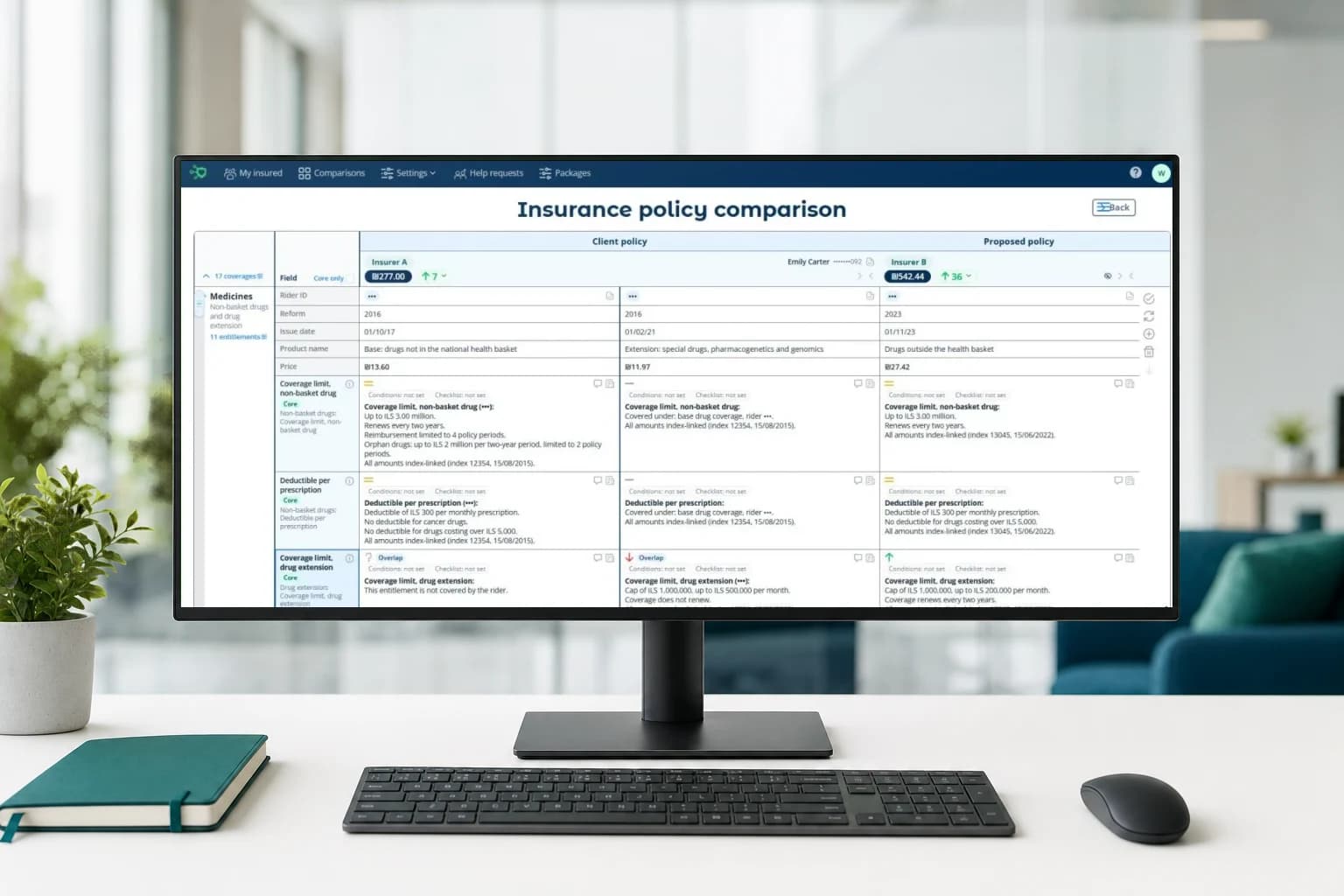
MediMe policy comparison: the client's policy and a proposed policy side by side, entitlement by entitlement, with the policy terms behind each one.
View the screen full size

Policy comparison

Entitlement by entitlement, with the policy terms behind each finding.

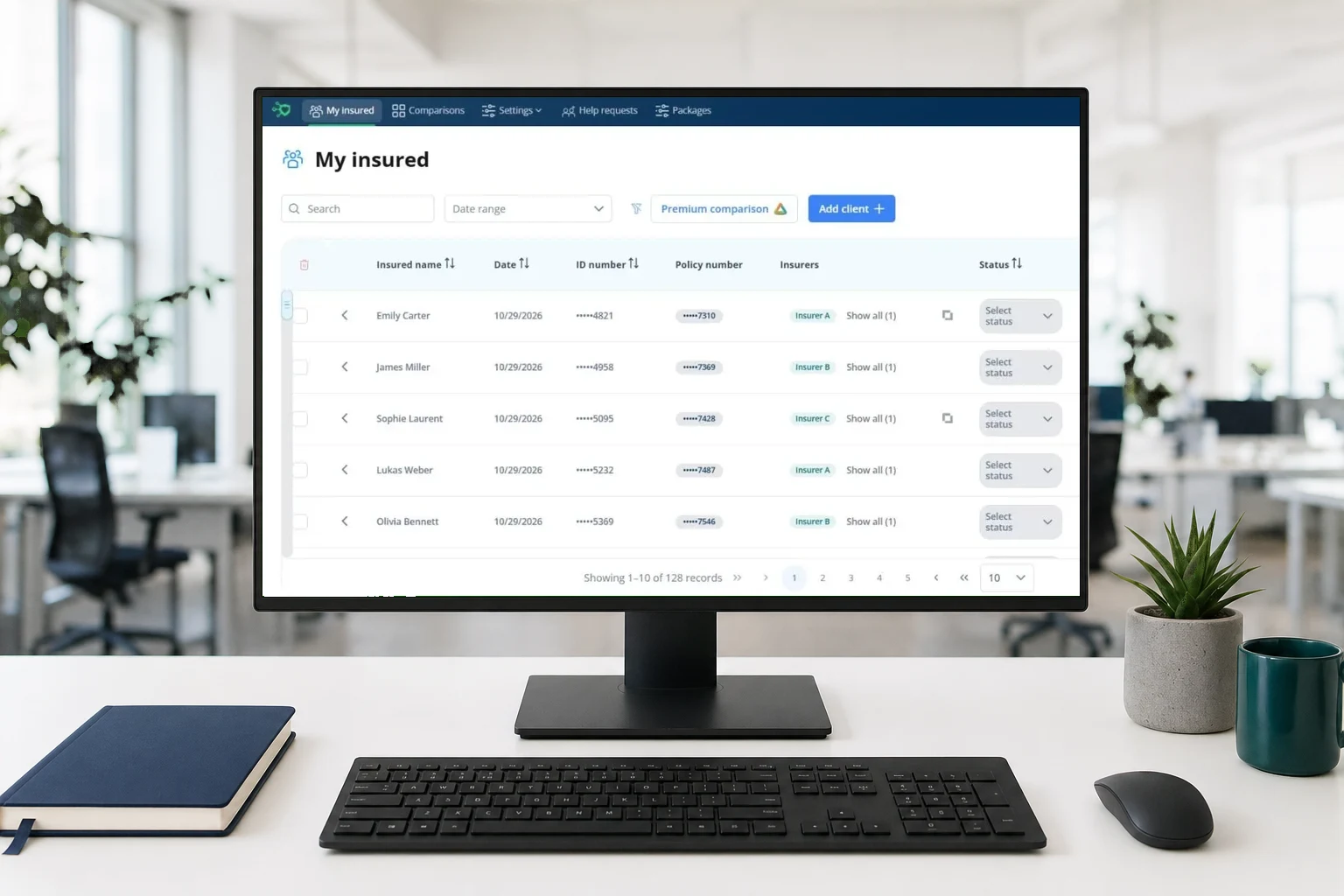
MediMe client list: insured clients with their policies, insurers and status.
View the screen full size

Book of insured clients

Every insured client with policies, insurers and status, and an offer one click away.

Screens from the MediMe agent system. The interface is in Hebrew and shown here in English for illustration; client names are samples, and identifying details and insurer names are hidden.

The business meaning

Serve more clients, proactively and consistently, with less manual work per process.

A broader operation
Carriers and agencies can run a larger volume of activity.
Personal attention for more clients
Proactive, consistent care, including for clients who did not reach out.
Expertise where it counts
Professionals are directed to where their experience and judgment create the most value.
A team seated around a table in a bright office, with one participant explaining to her colleagues.

The next step

Start with the journey that matters most to you.

Tell us which process you would start with: renewals, sales, service or claims. Together we will review the information sources, the approval points and the measures of success.